
Kanchanjunga North and South Base Camp: Pangpema and Oktang
Written by our trekking team
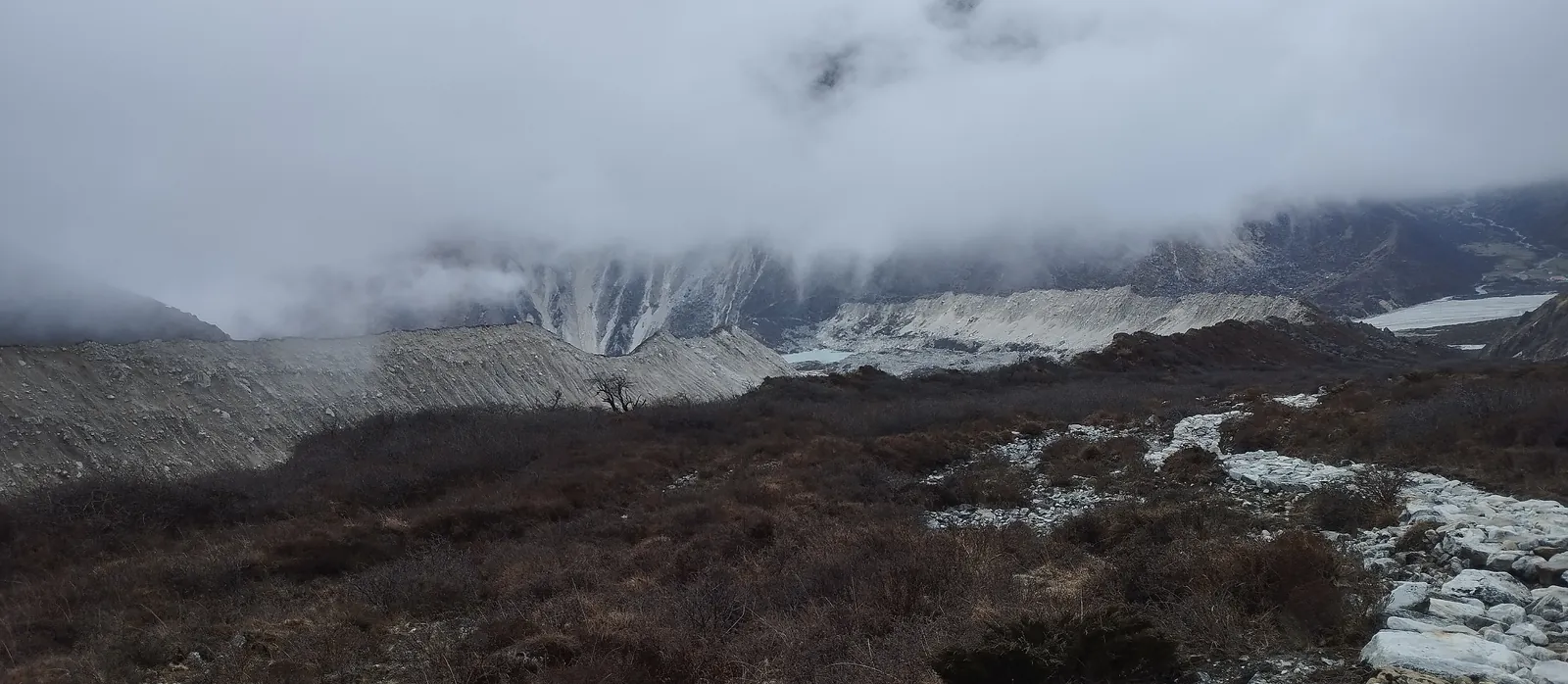
Photo: Remote Nepal Treks, 1 May 2023.
The short version
You don't have to choose. Our 21-day Kanchanjunga trek reaches both base camps. Pangpema, the North Base Camp, is the high point at 5,140m, walked out and back from Lhonak on Day 13 under Kanchanjunga's north face. Oktang, the South Base Camp viewpoint, is 4,730m, reached from Ramche on Day 17 after the Sele La crossing. The north side has basic lodges, the south side is camp-supported, and three acclimatization stops pace the climb.
Two base camps, one mountain
Most base camp treks take you to one side of one mountain and back. Kanchanjunga is different. Our 21-day route reaches both of its base camps: Pangpema on the north side and Oktang on the south. As far as we know, it's the only trek in Nepal that puts you on both sides of an 8,000m peak in a single trip.
That's also why the trek is long. There's no shortcut between the two halves. You go up the north side to Pangpema, come back down to Ghunsa, cross the Sele La passes, and then go up the south side to Oktang. Kanchanjunga (8,586m), the world's third-highest mountain, sits between the two.
If you've searched for “Kanchenjunga North Base Camp” or “South Base Camp”, these are the same places. Kanchanjunga and Kanchenjunga are two spellings of one name.
Pangpema and Oktang side by side
| Pangpema (North) | Oktang (South) | |
|---|---|---|
| Altitude | 5,140m, the trek's high point | 4,730m |
| Day | Day 13 | Day 17 |
| Starting from | Lhonak, 4,780m | Ramche, 4,580m |
| Walking | ~10km, 5 to 6 hrs, out and back | ~9km, 5 to 6 hrs, then down to Tseram |
| What you see | Kanchanjunga's whole north face, right overhead | The south face and the Yalung Glacier's amphitheater |
| Nights nearby | Basic lodges at Khambachen and Lhonak | Camp, with our kitchen crew |
Pangpema is higher and more dramatic. Oktang comes after the hardest day of the trek, so getting there feels like a reward. You won't be choosing between them on our route, but they feel quite different.
The north side: Ghunsa to Pangpema
The north side is where the altitude builds, and the itinerary takes it slowly. Ghunsa (3,595m) is the hub village and the KCAP checkpoint, and you get a full acclimatization day there on Day 9. Then it's on to Khambachen (4,050m), where you get your first close look at Jannu, and another rest day on Day 11 with an optional hike toward the Jannu Base Camp trail.
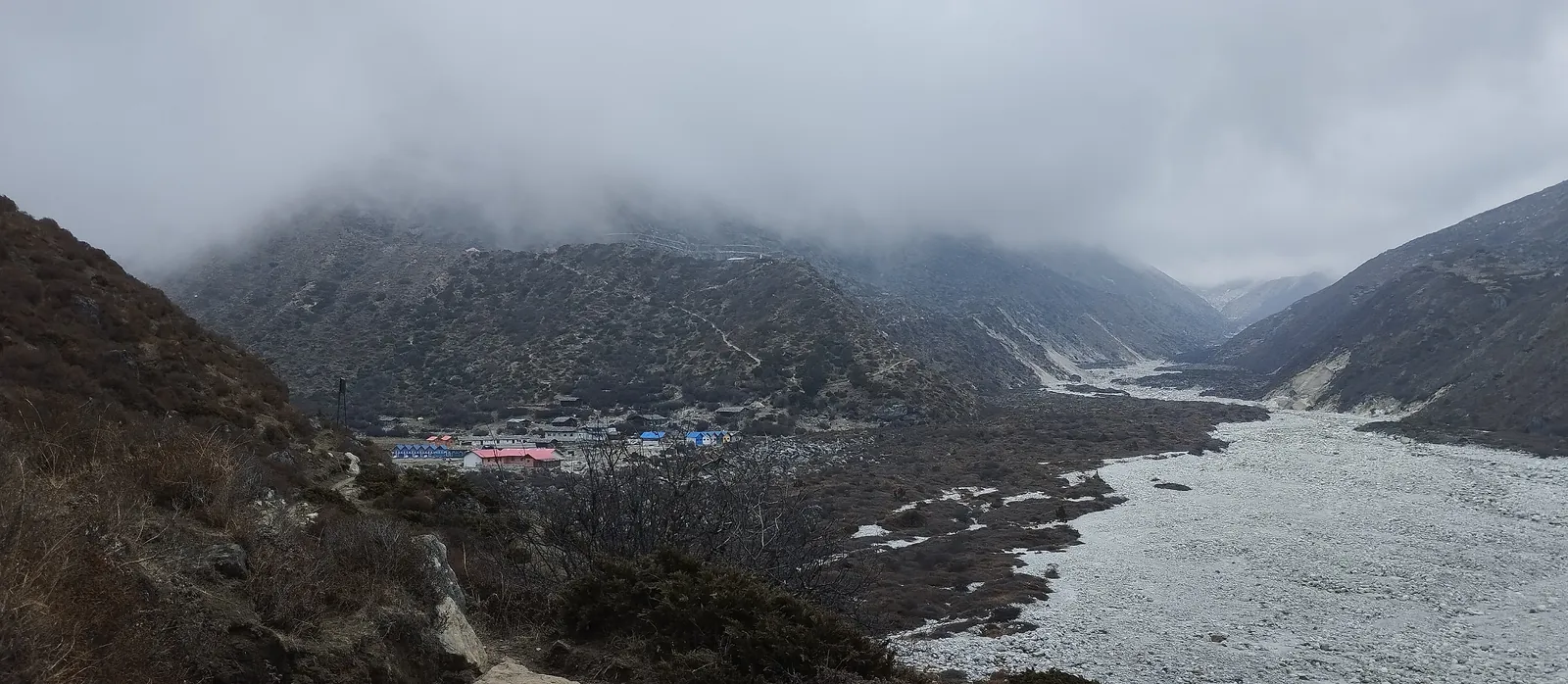
Photo: Remote Nepal Treks, 30 Apr 2023.
Day 12 is a rough, exposed traverse above the Kanchanjunga Glacier's lateral moraine to Lhonak (4,780m), about 9km in 4 to 5 hours. Lhonak is the staging point. Nights there are in a camp or a basic lodge.
Pangpema day. On Day 13 you follow the glacier's true left bank up to Pangpema at 5,140m. Kanchanjunga's north face fills the sky above you. Then you walk back down to Lhonak for the night. It's about 10km and 5 to 6 hours in all, with 360m up and 360m back down. Because you return to the same altitude, the day itself works as part of your acclimatization.
Day 14 is a long descent back through Khambachen to Ghunsa, to rest and resupply before the passes.
Between the two: the Sele La
To get from one side to the other, you cross the Sele La complex on Day 15. It's three linked passes, the Sele La, Sinion La and Mirgin La, all above 4,200m, with no village between Ghunsa and Cheram. It takes 8 to 9 hours and it's the hardest day of the trek.
We only cross with a clear forecast, and there's a weather buffer day in the schedule so we never have to push it. When our team crossed on 3 May 2023, the passes were snow-covered at about 4,570m. You can read that day in our account of the trek in spring.
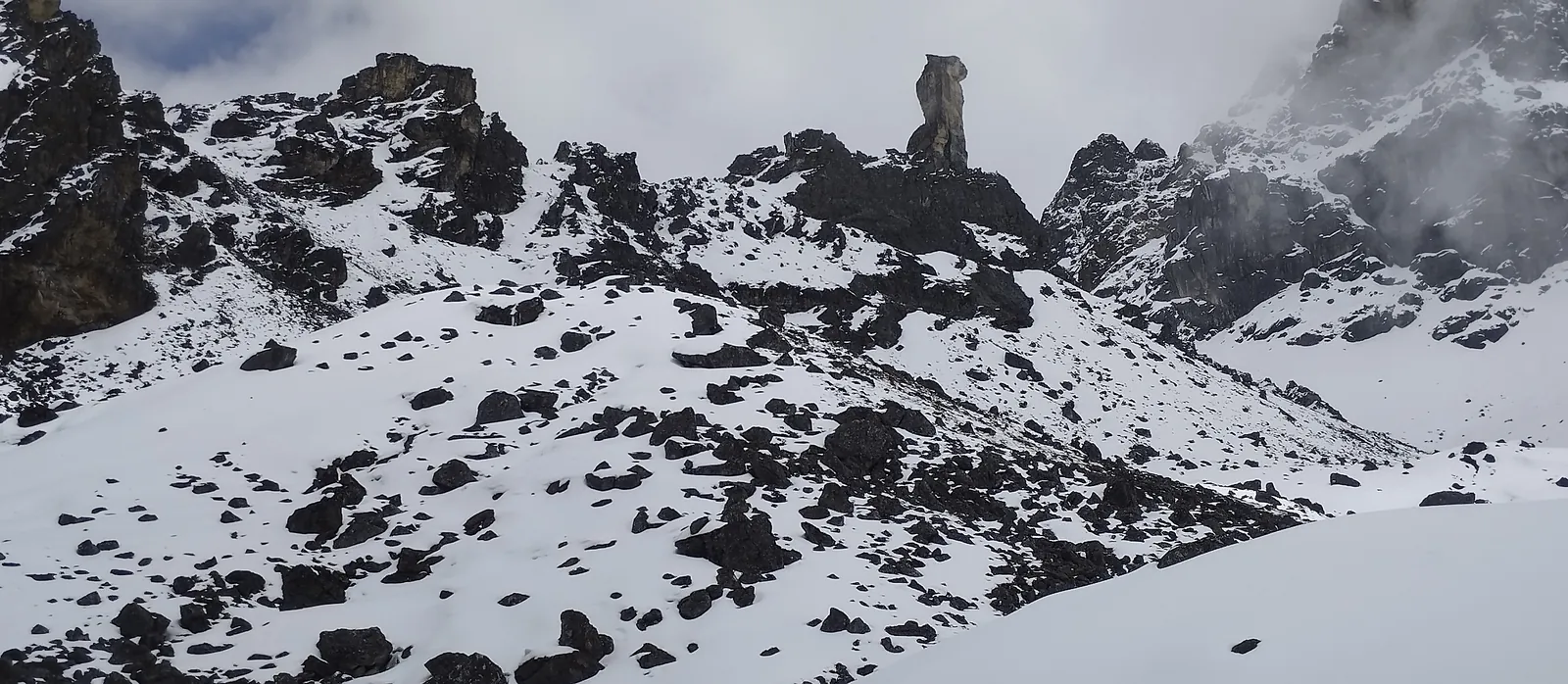
Photo: Remote Nepal Treks, 2–3 May 2023.
The south side: Cheram to Oktang
After the passes, the south side is gentler. Day 16 is a short recovery day from Cheram (3,870m) up the Yalung Glacier's valley to Ramche (4,580m).
Oktang day. On Day 17 you climb to the Oktang viewpoint at 4,730m, with Kanchanjunga's south face and the Yalung Glacier amphitheater in front of you. Then you head back down past Ramche to Tseram for the night, about 9km and 5 to 6 hours in all.
This side is the most remote part of the route. Facilities are sparsest here, so our kitchen crew handles meals and the nights are in camp. After Oktang it's all downhill: Torontan, then Yamphudin on Day 19, where proper teahouses come back for the first time since Ghunsa.
A note on our own photos
Our team's 2023 trip didn't run the full route. It went up the north side as far as Khambachen and the trail toward Jannu, came back to Ghunsa and crossed the Sele La from there. So we have no photos of our own from Pangpema or Oktang, and we won't use anyone else's here.
What you see on this page is the ground on the way to each base camp. All 23 of our photos from that trip, with dates, are in the Kanchanjunga trek journal.
Is the two-base-camp trek right for you?
We grade Kanchanjunga Very Challenging. It's 21 days with 18 days on foot, several nights above 4,500m, and the Sele La in the middle. We'd encourage at least one earlier trek above 4,500m first, ideally one with a high pass. The Larkya La on the Manaslu Circuit is a good one.
The good news is how it's paced. There are three acclimatization stops (Ghunsa, Khambachen and the out-and-back to Pangpema), and above Ghunsa an assistant guide joins your licensed guide. Your guide team carries a pulse oximeter and a full first aid kit, and has an evacuation plan ready.
And the quiet is real. Kanchanjunga sees a small fraction of the trekkers on Everest Base Camp. On the Ghunsa to Lhonak stretch it's common to go a whole day without passing another group. Groups need at least two trekkers for the permit, and we cap them at six on this route.
For permits, seasons and the rest, start with our Kanchanjunga Trek guide. Every day of the route is in the 21-day Kanchanjunga itinerary.
Frequently asked
Does the Kanchanjunga trek go to both base camps?
Yes. Our 21-day route reaches Pangpema, the North Base Camp, on Day 13 and the Oktang viewpoint on the south side on Day 17, crossing the Sele La passes in between.
How high is Kanchanjunga North Base Camp?
Pangpema is 5,140m, the highest point of the trek. You walk there and back from Lhonak (4,780m) in a day, about 10km and 5 to 6 hours.
How high is Kanchanjunga South Base Camp?
The Oktang viewpoint is 4,730m. You climb to it from Ramche (4,580m) on Day 17, then descend to Tseram for the night, about 9km and 5 to 6 hours.
Which base camp is better, north or south?
They're different. Pangpema is higher and puts Kanchanjunga's whole north face right above you. Oktang looks onto the south face and the Yalung Glacier's amphitheater. Our itinerary visits both.
Why does the Kanchanjunga trek take 21 days?
Because there's no shortcut between the two base camps. You go up the north side to Pangpema, back to Ghunsa, over the Sele La complex, then up the south side to Oktang, with a long approach from Taplejung at the start.