
Crossing the Larkya La: what the Manaslu pass day is like
Written by our trekking team
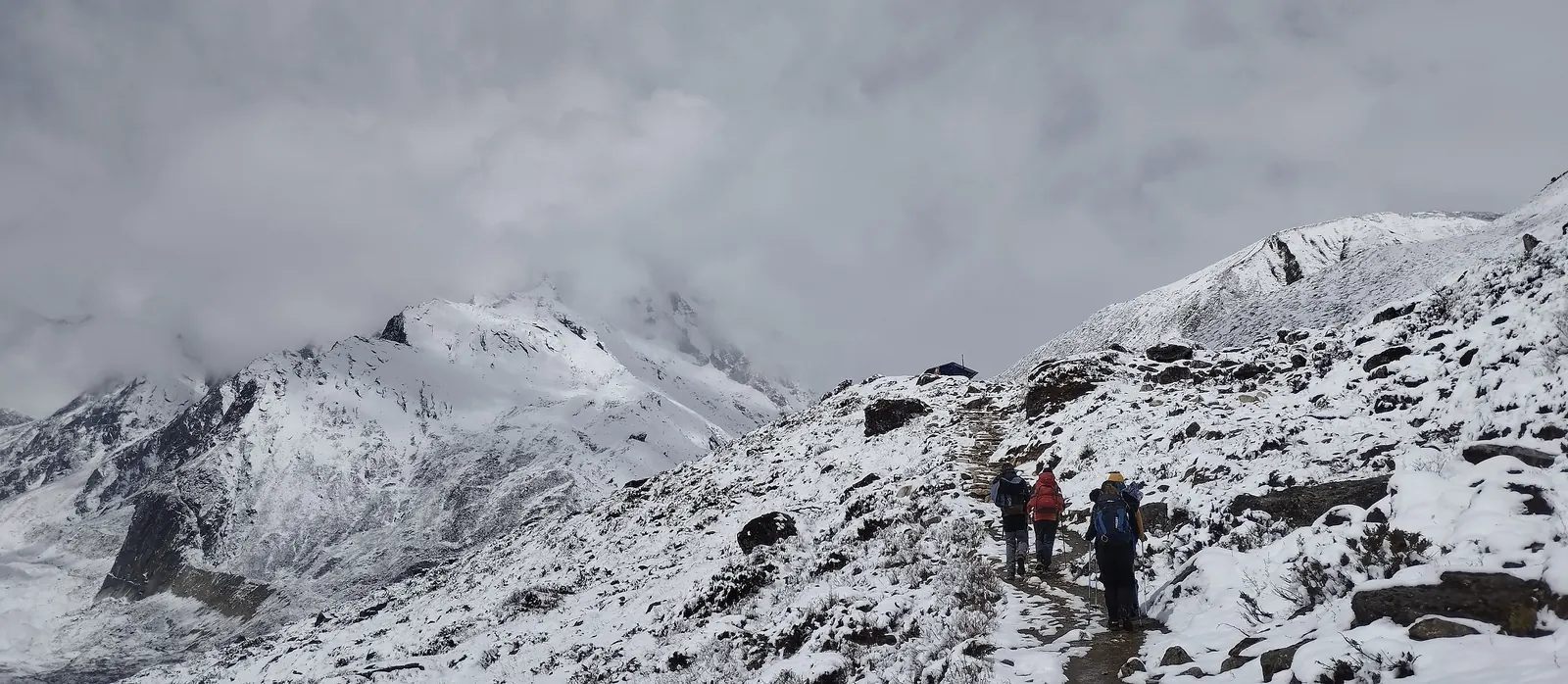
Photo: Remote Nepal Treks, 1 Apr 2023.
The short version
The Larkya La (5,106m) is Day 11 of our Manaslu Circuit, and it's the longest day of the trek: about 26km and 8 to 9 hours from Dharamsala to Bimtang. You leave by headlamp, climb 646m to the top, then drop 1,386m into the glacial meadow at Bimtang. It isn't technical, with no ropes or crampons on the standard route. By the time you get there you've had a rest day at Samagaon and a staging night at 4,460m, so it's a hard day you're ready for.
Pass day at a glance
Day 11 is the one the whole circuit builds toward. Here it is in numbers, with the short day before it, because the two belong together.
| Stage | Altitude | Change | Time / distance |
|---|---|---|---|
| Day 10: Samdo to Dharamsala | 4,460m | ▲ 600m | 3–4 hrs, ~7km |
| Day 11: Dharamsala to the Larkya La | 5,106m | ▲ 646m | 8–9 hrs, ~26km in all |
| Day 11: Larkya La to Bimtang | 3,720m | ▼ 1,386m |
Look at the last column. The climb is the part people worry about, but the descent is longer, and the day as a whole is the longest on the trek.
The night at Dharamsala
Pass day really starts the afternoon before. Day 10 is short on purpose: about 7km and 3 to 4 hours from Samdo up to Dharamsala, also called Larke Phedi, at 4,460m. That's the highest night you'll spend on the trek.
Dharamsala isn't a village. It's a few basic lodges sitting right under the pass, and they're there for one reason. You arrive early, eat an early dinner, lay out your layers for the morning and get into your sleeping bag.
Your guide checks your oxygen saturation with a pulse oximeter, the same check they've done at every stop above 3,000m. You both go to bed knowing how you're doing.
It's cold. A sleeping bag rated to at least −15°C earns its place on this night more than any other.
Leaving by headlamp
You set off in the dark. The wind on the Larkya La picks up in the afternoon, and the whole plan for the day is to be over the top and well into the descent before it does.
So the first stretch is by headlamp. Put fresh batteries in the night before and keep the spares somewhere warm.
Then the light comes up and the peaks around the pass turn from grey to gold. It's the best part of the morning, and the photo below was taken in it.
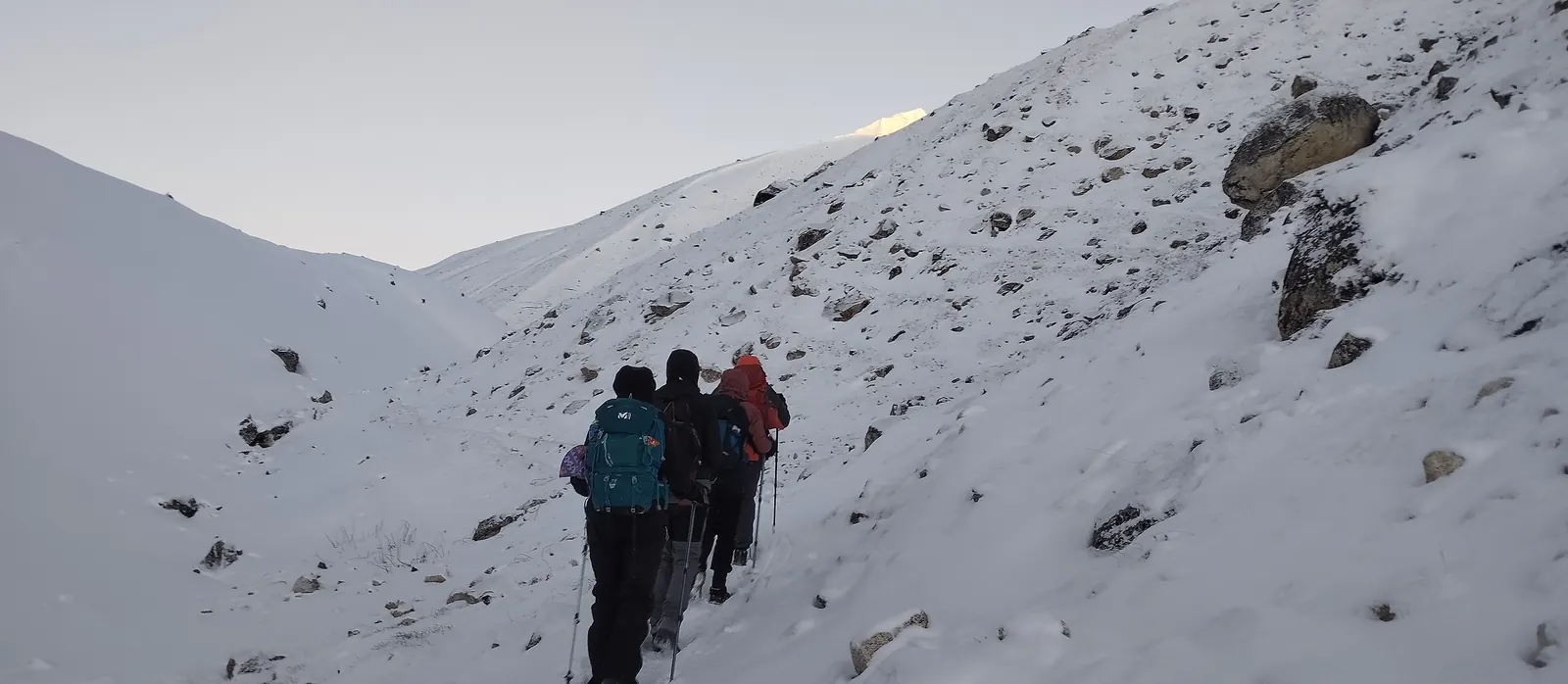
Photo: Remote Nepal Treks, 2 Apr 2023.
The climb to 5,106m
From Dharamsala it's 646m up to the top. None of it is technical. There's no rope work and no crampons on the standard route, just a trail that climbs steadily through cold, thin air, sometimes over snow.
The altitude is what makes it hard. Above 5,000m every step costs more breath than it would at home, so the pace is slow and that's fine. Nobody is racing. Your guide sets a rhythm you can hold for hours, and stops are short so you don't get cold.
If you've read our honest difficulty grade, this is the day that puts the circuit in the Challenging bracket.
On top of the Larkya La
At 5,106m (16,752ft) the Larkya La is the highest point of the circuit, and the view is the reward. You get a wide panorama that takes in Himlung, Cheo and Annapurna II.
Take your photo. Have a snack. Don't stay long, though. The cold and the wind are why you left in the dark, and there's still a long way down.
Down to Bimtang
The descent is the longer half of the day. You drop 1,386m from the pass to Bimtang at 3,720m.
Early on, that can mean a steep snowfield on the Bimtang side. That's what we came down in 2023 (Exhibit C). Trekking poles make a real difference here, and so do gaiters if there's fresh snow.
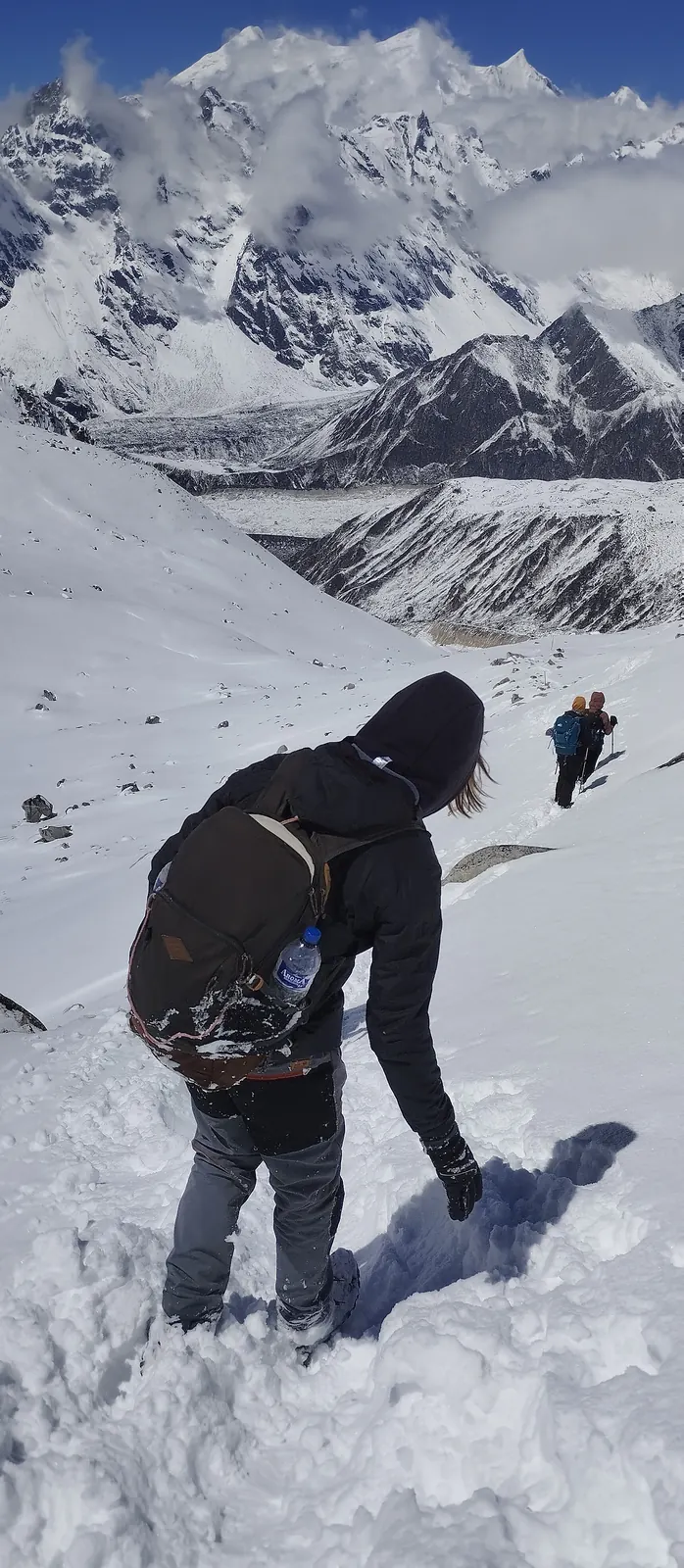
Photo: Remote Nepal Treks, 2 Apr 2023.
Lower down the gradient eases, the air gets thicker, and you walk into Bimtang's glacial meadow with Manaslu's west face rising behind you. After a day like that, a teahouse bed at 3,720m feels luxurious.
Day 12 is downhill all the way, through pine and rhododendron forest to Tilije, where the walking ends.
Our crossing in 2023
We crossed on 2 April 2023. The day before, fresh snow fell overnight at Samdo, and the whole valley up to Dharamsala was white. The photo at the top of this page is the trail that afternoon.
It looked dramatic. It didn't change the plan. We walked up to Dharamsala as scheduled, left by headlamp the next morning and crossed at first light.
That's spring on Manaslu: a little warmer, with the odd snowfall up high. Autumn gives you the most reliable conditions on the pass, with clear, settled skies after the monsoon. Both work, and we run the same itinerary in each. Our spring vs autumn comparison goes through the differences.
Why you're ready for it
The Larkya La gets talked about as the scary part of Manaslu. It's the hardest day, and we won't pretend otherwise. But the four days before it are there to get you ready.
- Rest day at Samagaon (Day 8). A second night at 3,530m, with an optional hike toward Manaslu Base Camp (around 4,800m) or a shorter walk to Pungyen Gompa. You climb high and sleep low.
- A short day to Samdo (Day 9). About 4 hours, up to 3,860m.
- The staging night (Day 10). Sleeping at Dharamsala means pass day starts only 646m below the top.
Your guide walks the whole day with you, with a first aid kit, a pulse oximeter and an evacuation plan ready for every trip. Once you're committed to the crossing there's no easy way to turn back halfway, which is why the checks at Samdo and Dharamsala matter: you start the day knowing how you're doing.
There's more on how the pacing works in our note on acclimatization on the restricted-area treks.
What to carry on pass day
Porters carry the shared load, so on the pass you carry a daypack. These are the things in it that matter most on Day 11:
Headlamp and spare batteries. You start in the dark.
Glacier-rated sunglasses. Fresh snow at 5,000m is very bright.
Down jacket and a windproof shell. For the pre-dawn start and the top.
Trekking poles and gaiters. The poles are for the descent. The gaiters are for snow near the pass, mostly early or late in the season.
Everything else is in the Manaslu packing list. To see where pass day sits in the whole trip, read the 15-day Manaslu route or start with our Manaslu Circuit Trek guide.
Frequently asked
How high is the Larkya La?
5,106m, or 16,752ft. It's the highest point on the Manaslu Circuit. The highest night's sleep is the one before, at Dharamsala (4,460m).
How long does the Larkya La crossing take?
8 to 9 hours. Day 11 covers about 26km, from Dharamsala up 646m to the pass and then down 1,386m to Bimtang (3,720m).
Is the Larkya La technical?
No. There's no rope or crampon work on the standard route. It's a long, steady climb on a trail, sometimes over snow, and the altitude is what makes it hard.
Why do you start the Larkya La before dawn?
The wind on the pass picks up in the afternoon. Leaving Dharamsala by headlamp gets you over the top and well into the descent before it does.
Can you cross the Larkya La after fresh snow?
Often, yes. On our 2023 trip fresh snow fell at Samdo on 1 April and we crossed the pass at first light on 2 April. Gaiters help near the start or end of either season.